
I recently published a novel entitled “L’Idiotine” (The Idiotin), which humorously recounts the adventures of Eliot Soulières, a researcher who has isolated a protein that, according to his friend Ché, is found mainly in the idiots and imbeciles of this world. Ché even suggests naming this protein “idiotin.”
The first comments I received from readers concerned the protein itself.
Does Idiotin really exist?
Recently, additional research conducted in secret in a corner of my basement, which I have converted into a laboratory, has enabled me to confirm that idiotin really does exist.
In fact, not only is idiotin present in humans, but it even comes in two forms: type 1 and type 2. Readers more knowledgeable in this field will soon be able to find a complete presentation of these results in the next edition of the Journal of Preposterous Hypotheses1.
1 Houde M.M., Soulières E.D., Chevalier C., M. Deschamps and Toure V. Identification of two forms of idiotin in humans. J. Prepost. Hyp. 11(1) : e45-51 (2026).
In this first article, we will first discuss type 1 idiotin. The current picture is as follows:
Type 1 Idiotin
Type 1 idiotin is a protein consisting of 395 amino acids. Anticipating some questions from readers less familiar with these biochemical concepts, I will take a brief pause to explain that amino acids, of which there are 22, are the building blocks or constituents of proteins. Depending on the sequence of amino acids, this protein chain will adopt a specific three-dimensional conformation, as nicely illustrated in the figure below.
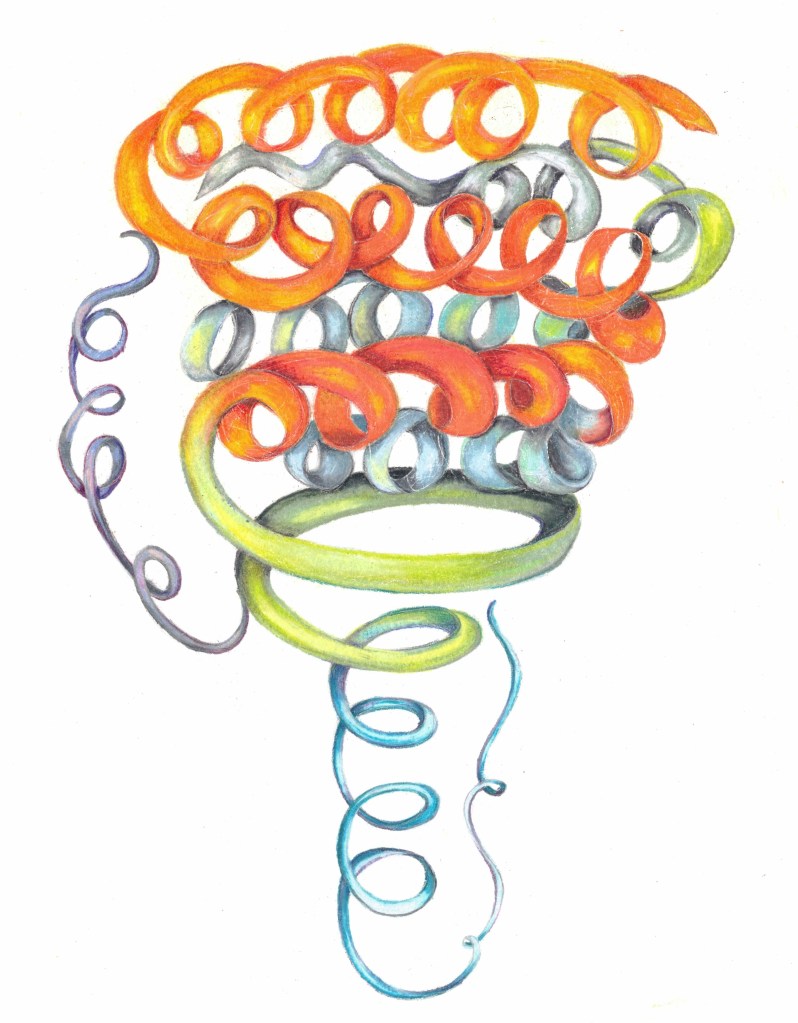
Artistic Representation of the structure of Type 1 Idiotin (Hélène Caza, 2026)
In the brain, the expression of type 1 idiotin is said to be constitutive, meaning that it is secreted continuously and permanently, unaffected by any environmental influences (stress, pathogens, diet, or other factors). In the vast majority of humans, very low levels are found in the cerebrospinal fluid, levels that appear to have no significant effect on the individual’s behavior. However, in about 10% of people, 100 to 1,00 times higher amounts of type 1 idiotin are produced, again constitutively. Recent epidemiological studies show a 91.6% correlation between these stratospheric levels of type 1 idiotin and the stupid actions of carriers1.
To name this condition, the term “idiotinemia” has been proposed by leading experts in the field (myself, in this case, since until recently I was the only one who knew about the existence of this protein; we work with what we have). Another interesting detail is that the proportion of individuals with high concentrations of type 1 idiotin rises to 20% in certain cohorts such as politicians, sports team owners, and reality TV show participants1.
Although type 1 idiotinemia may seem harmless at first glance, some of its manifestations can cause significant and pernicious damage. Let’s look at three concrete examples of type 1 idiotinemia 1.
Example # 1
We have chosen a Canadian example for this first scenario.
Federal IT Modernization Faces Multi-Billion Dollar Cost Overruns
This example being just one of many government projects, how can we explain these astronomical cost overruns other than by constant levels of type 1 idiotin affecting the brain of the managers of these government projects?
I was about to apologize to my non-Canadian readers, assuming they would have some difficulty understanding this example, when another article about the implementation of this software appeared this week, reporting the existence of the same phenomenon in several other countries. Although it is sad to see that it is the same everywhere, allow me to be satisfied that I can thus demonstrate the universality of my postulate
.
Problems around the world with Cúram (in French only)
Example # 2
Let’s now use the wonderful world of sports for our second example, namely the dismal performance of the New York Jets, a professional American football team.

Once again, how else can we explain the team’s lamentable management over such a long period of time other than by the enormous production of type 1 idiotin?
On the other hand, it is interesting to note that in 2024, this NFL franchise was valued at $7.35 billion, ranking seventh among the league’s 32 franchises, with profits of $145 million. The well-known expression “happy fool” takes on its full meaning here, at least as far as the owners are concerned, if not the fans.
Example # 3
We will remain in the United States for our final example. This time, we will draw on the collection of absurd statements made by the honorable Robert F. Kennedy Jr., who is none other than the United States Secretary of Health and Human Services. We will limit ourselves to five of these statements, made over a period of several years, none of which being based on evidence validated according to recognized scientific criteria. This last example illustrates the persistence of this condition in certain individuals and should suffice to demonstrate beyond any doubt the existence of type 1 idiotenemia.





Note: The statements were probably not made when these photos were taken, although this remains possible. However, various sources confirm that the person appearing in these photos is indeed the author of these statements..
And to conclude, for the same price, a fun fact:
It should also be noted that Georges Brassens, the great French poet, intuitively referred to people affected by type 1 idiotinemia, the permanent form of the disease, in his famous song “Le temps ne fait rien à l’affaire” (Time does nothing to help), which I can already hear you singing along to:
Le temps ne fait rien à l’affaire,
Quand on est con, on est con.
Qu’on ait vingt ans, qu’on soit grand-père,
Quand on est con, on est con.
Entre vous, plus de controverses,
Cons caducs ou cons débutants,
Petits cons d’ la dernière averse,
Vieux cons des neiges d’antan
Time changes nothing,
When you’re a fool, you’re a fool.
Whether you’re twenty or a grandfather,
When you’re a fool, you’re a fool.
Between you, no more arguments,
Expired idiots or budding idiots,
Little idiots of the last downpour,
Old idiots of yesteryear’s snows.
If this song doesn’t define people afflicted with type 1 idiotinemia, I’d like to know what does.
That’s all for today. In a future article, we’ll examine type 2 idiotin.


 Pincées d'Idiotine
Répondre à Michel Houde Annuler la réponse.